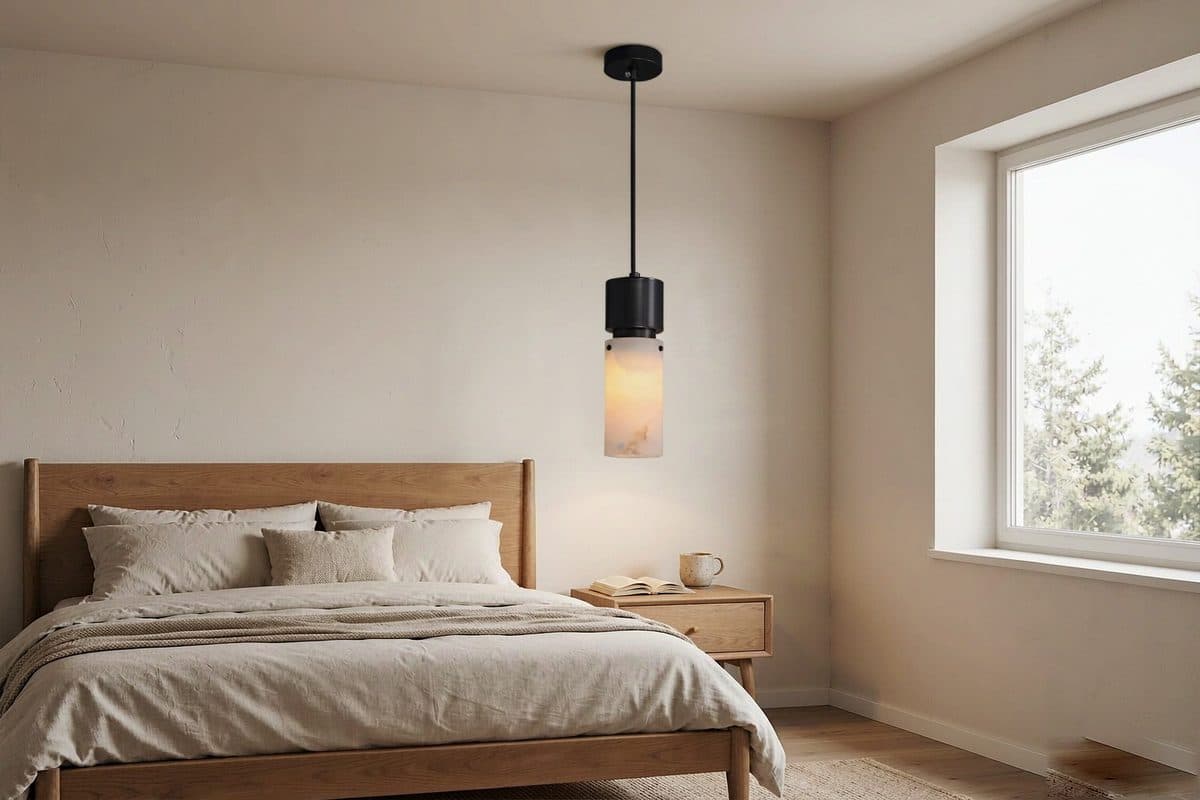
1. The Material Is Scarce and Yield Is Low
Natural alabaster and quality travertine are extracted in blocks, and only a fraction of each block becomes a lighting shade. Veins that crack during cutting, color changes that break the banding, and hidden flaws disqualify large portions of every block. If a workshop needs ten flawless shades, it may cut through the equivalent of fifteen. That reject material isn't free — it was mined, transported and paid for.
Glass, metal and resin, by contrast, convert nearly 100% of input into product. This single difference explains most of the price gap.
2. Every Piece Is Hand-Finished
A metal shade is stamped; a glass shade is machine-blown; a stone shade is ground, carved, sanded and inspected by hand. Shaping a curved alabaster profile to a smooth, even wall thickness takes hours and years of experience. Hand labor at this skill level is the second-largest cost component.
3. Matching Is Labor Too
For a three-pendant cluster or a hotel corridor of twenty fixtures, the workshop must select shades whose banding and tone look related. That means sorting, comparing and sometimes setting aside stock until a matched group exists. Matching time is invisible in the product but very real in the price.
4. Weight, Fragility and Packing Cost
Stone is heavy and fragile — the two most expensive properties a shipping box can have. Professional packing means molded foam cradles, rigid double-wall cartons, and packing labor per unit. Freight is billed by weight, and damage claims are absorbed somewhere in the chain. A fixture packed properly costs more to ship than a metal one of the same size, and that cost is legitimate.
5. Physics You Can't Fake
The reason customers fall in love with alabaster in person is translucency: light passes through the mineral structure and comes out warm, soft and seemingly sourceless. Resin can imitate the look in photos. In a dark room, the difference is obvious to anyone standing there. The value isn't the stone as decoration — it's the stone as a light engine, and no cheap material replicates it.
How to Communicate the Value
Give sales teams and product pages the language:
"No two pieces are alike" — frame variation as authenticity, with photography that celebrates banding differences.
"Hand-shaped from a single block" — one sentence that justifies the price and the lead time.
"Glows rather than shines" — describe the light behavior, not the material. This is what customers actually buy.
Show the process — quarry, workshop and inspection photos do more selling than any spec table.
Where Stone Lighting Doesn't Make Sense
Being honest about limits builds trust: stone pendants are the wrong choice where fixtures take daily physical impact, where they will be exposed to weather, or where budgets exclude anything beyond commodity lighting. In those cases, a stone-look line delivers the aesthetic at a fraction of the cost — which is exactly why a good catalog carries both.
The Wholesale Buyer's Angle
For importers and distributors, the premium segment works differently from commodity lighting:
Margins are higher per unit, and price competition is lower because supply of genuine natural stone is naturally limited.
Returns are driven by handling, not defects — clear packing and lamp guidance prevents most of them.
Customers who buy one natural stone fixture usually return for more rooms; the material creates loyalty.