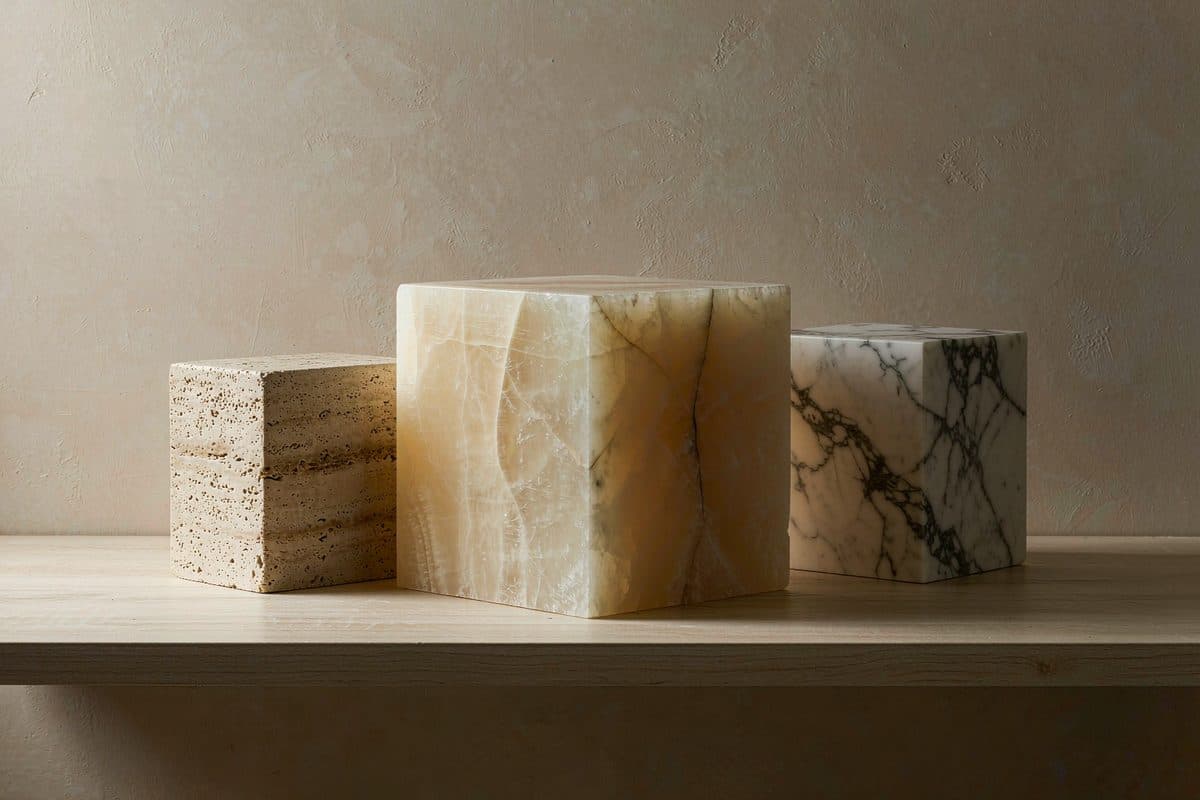
Alabaster: The Translucent One
Appearance: creamy white to honey tones with soft, cloudy banding. No hard edges or dramatic contrast.
Light behavior: the defining trait — alabaster is translucent, so the lamp glows through the stone. It diffuses light into a wide, warm pool with no visible hotspots.
Weight and strength: light for a stone (easy to hang on standard canopies), but soft — it scratches and chips more easily than marble.
Best for: bedrooms, dining rooms, hotel guest rooms, anywhere the glowing shade is the hero. If your customers ask for "that glowing stone lamp," they mean alabaster.
Travertine: The Textured One
Appearance: beige, cream or golden with characteristic pitted holes and linear sediment banding. Every piece looks like a slice of warm, sandy cliff.
Light behavior: travertine is mostly opaque. Light comes out of the openings of the shade, not through the walls. Fixtures lean on exposed lamps, open frames or diffusers.
Weight and strength: moderately porous but structurally sturdy for sconces and small shades. The natural pits collect dust, so cleaning guidance matters.
Best for: wall sconces, entryways, spaces that want earthy texture rather than glow. Travertine pairs beautifully with white walls and warm wood.
Marble: The Dramatic One
Appearance: strong veining in grey, green or brown across white or dark backgrounds. High-gloss or honed finishes.
Light behavior: opaque, with thin-wall designs allowing a faint halo at the edges. Marble fixtures usually feature the stone as a sculptural body rather than a diffuser.
Weight and strength: hardest of the three; resists chipping but is heavier — larger marble shades need reinforced mounting.
Best for: statement pieces, luxury retail, lobbies. Marble reads formal and expensive.
Quick Comparison
Alabaster | Travertine | Marble | |
Light through stone | Yes — glows | No | Barely |
Texture | Smooth, banded | Pitted, banded | Veined |
Weight | Light | Medium | Heavy |
Softness | Soft, can chip | Medium | Hard |
Typical vibe | Warm, serene | Earthy, organic | Formal, dramatic |
Price level | Mid–high | Mid | High |
The Stone-Look Question
Resin and ceramic "stone-effect" finishes have improved dramatically. They weigh less, cost less and survive shipping better. They cannot, however, reproduce translucency — an alabaster-look shade lights up like painted glass, not like glowing stone. The right approach for a catalog is to carry both: stone-look lines for price-sensitive segments, natural stone for the premium tier where the material is the selling point.
Building a Range Around the Three Stones
A balanced wholesale assortment typically looks like this:
Alabaster pendants as the emotional core — globes, cylinders, lanterns.
Travertine sconces and small pendants as the earthy complement — entryway and hallway coverage.
Marble or black stone-effect pieces as the dramatic accents — statement listing images that anchor the catalog.
This structure lets a buyer shop by mood: glow, texture or drama — while all three families share similar metal finishes (brass, black, nickel) so the range looks coherent.