Why Stone Pendants Suit Small Spaces
A pendant hangs in the air and uses no floor or table surface — a real advantage where every square decimeter counts. Natural stone shades add something else small spaces need: a single strong material moment. Instead of filling a tiny room with decoration, one glowing alabaster globe becomes the whole design.
They also solve the classic small-space lighting problem: the fixture is visible from everywhere, including from the next room. A shade that looks beautiful from the side — as alabaster does when lit — turns an awkward view line into a feature.
Entryways (Even 2 m² Ones)
Size: 15–25 cm diameter globe or dome, or a tall cylinder if the ceiling is standard height.
Height: center the shade at least 2 m from the floor so coats and doors clear it.
Placement: center over the landing point — the spot where people actually stop to take off shoes — not the geometric middle of the room.
Lamp: 450–600 lumens, 2700K, dimmable if the entry connects to the living room.
If the ceiling is very low, choose a flush-mount stone ceiling light instead of a pendant; the material effect survives, the headroom survives.
Reading Nooks and Corners
The formula that always works: one armchair + one small side surface + one pendant hanging 40–50 cm above the surface, positioned at the reader's shoulder.
Size: 10–15 cm globe or small dome.
Lamp: 300–450 lumens, warm, dimmable — reading corners live on the dimmer.
Bonus: where no ceiling outlet exists, specify extra cord and a swag hook so the drop point can sit above the corner even when the junction box doesn't.
Alcoves, Niches and Awkward Wall Returns
Older buildings love odd niches. Rather than ignoring them:
Hang a very small pendant (8–10 cm globe) inside the niche at eye height — it becomes a luminous object, like art.
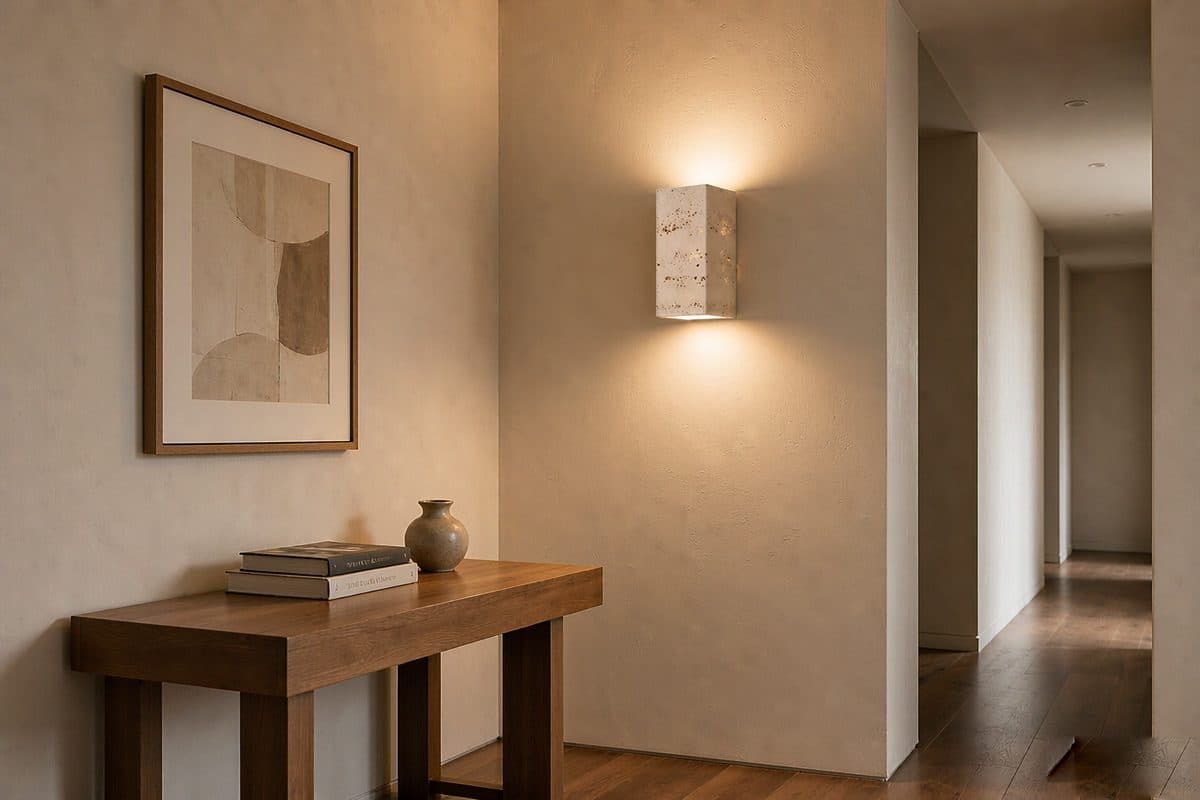
Or mount a stone sconce centered in the niche; travertine bodies look like carved exhibits in shallow recesses.
Light these spots on a separate switch so they can stay on at night as wayfinding.
Bathrooms and Vanities (Dry Zones)
A small stone pendant beside (not over) the mirror adds warmth that downlights destroy. Use only outside splash zones, with rated components, and pair with a dimmable warm lamp.
Stair Landings and Half-Landings
A pendant centered on a stair landing is one of the highest-impact placements in a home: it's visible from both floors. Choose a shade that looks good from above as well — globes and lantern shapes with interesting banding are ideal. Check that the shade clears head height on the ascending flight by at least 2 m.
Sizing Rules of Thumb
Diameter in cm ≈ room width in meters × 20–25 (an entry nook 1.2 m wide → 24–30 cm fixture, though compact shades at the lower end usually look better).
When torn between two sizes, go smaller and hang slightly lower — intimacy beats scale in small rooms.
Keep the bottom of the shade above 2 m anywhere people walk.