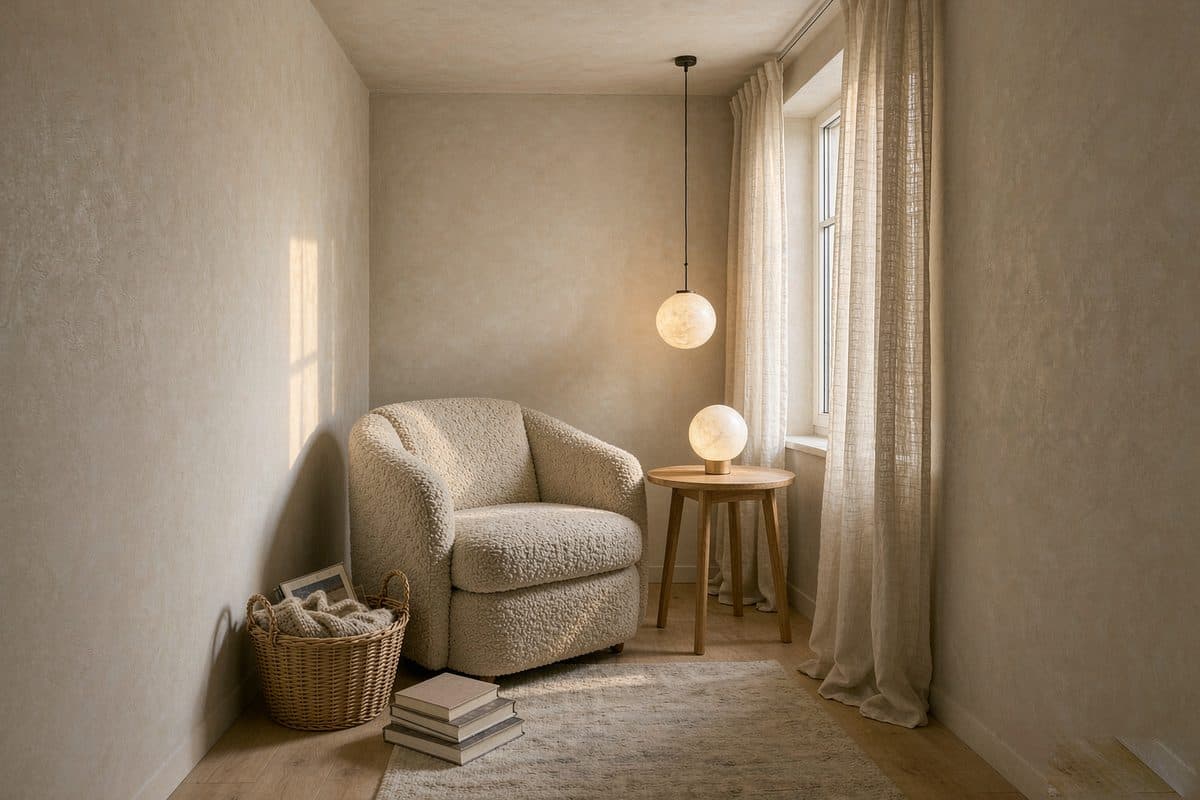
What the Styles Demand from a Light Fixture
Japandi wants calm, function and craftsmanship. Fixtures should be geometric but soft — globes, cylinders, gentle domes — in warm neutrals with understated hardware. Nothing glossy, nothing ornamental.
Wabi-sabi wants authenticity and imperfection. A stone shade with uneven banding, a surface pit, or a slightly irregular edge is not a defect in this context — it is the point. Mass-produced perfection reads wrong; natural variation reads right.
Alabaster and travertine satisfy both briefs almost automatically. The stone is matte, tactile, warm-toned and literally one of a kind.
Shapes That Work
Sphere/globe pendants (10–25 cm): the most versatile. In Japandi rooms they echo paper lanterns without the fragility.
Tall cylinders: architectural and quiet; excellent over kitchen islands and beside beds.
Low, wide domes: suit low tables and reading corners.
Sculpted organic shapes (petal, lantern, layered discs): use sparingly — one statement piece per room keeps the calm.
Sconces with travertine bodies: for hallways and beside mirrors, where the stone texture can be seen up close.
Color and Finish Pairing
Stone lighting carries three metal families that map cleanly onto these interiors:
Brass — adds a quiet glow against oak and walnut; best in slightly warmer Japandi rooms.
Black — the Japanese-influenced choice; grounds pale rooms and echoes window frames.
Nickel/grey steel — the Scandinavian-influenced choice; cooler and more minimal.
One rule keeps it simple: repeat the metal finish at least twice in the room (pendant + sconce, or pendant + furniture legs) so it looks specified rather than accidental.
Room-by-Room Notes
Entryway: one stone pendant or a travertine sconce pair on a plaster wall; keep light warm (2700K) so the first impression is soft.
Living room: a single larger alabaster pendant centers the seating group; add a stone table lamp if the room is large, rather than more pendants.
Dining: low-hung alabaster over the table, ideally 60–70 cm above the surface so the glowing stone sits in the sightline while seated.
Bedroom: bedside pendants instead of table lamps — the single most requested change designers make in these projects.
Bathroom (dry zones): travertine sconces beside the mirror give the wabi-sabi texture without humidity exposure.
Lighting Values for Calm Interiors
2700K everywhere; 3000K only in task-heavy kitchens.
Dimmable lamps in every fixture — calm rooms change light level through the day.
Avoid mixing cool accent lighting with stone fixtures; the stone turns grey and lifeless under 4000K light.
Common Styling Mistakes
Hanging stone pendants too high — these styles rely on intimacy, and high pendants disconnect from the room.
Oversizing: in Japandi, three small pendants usually beat one giant one.
Pairing glossy furniture with matte stone without a bridge texture (linen, boucle, raw wood) between them.