Stage 1: Shortlist and First Contact
Gather 3–5 models that suit your market, then contact the supplier with specific questions rather than "how much?":
Is the shade natural stone, or a stone-look composite?
What lamp type and voltage does the fixture support (E26/E27, G9; 110–120V vs 220–240V)?
What is the cord length, and is it adjustable?
Which certifications or test reports exist for your market?
A supplier's speed and specificity in this first reply tells you most of what you need to know about the working relationship ahead.
Stage 2: The Sample Order
Never skip samples for natural stone products — photos cannot convey translucency, banding or finish quality.
Order one unit of each shortlisted model, paying sample fees and shipping if asked; many suppliers credit these against the bulk order.
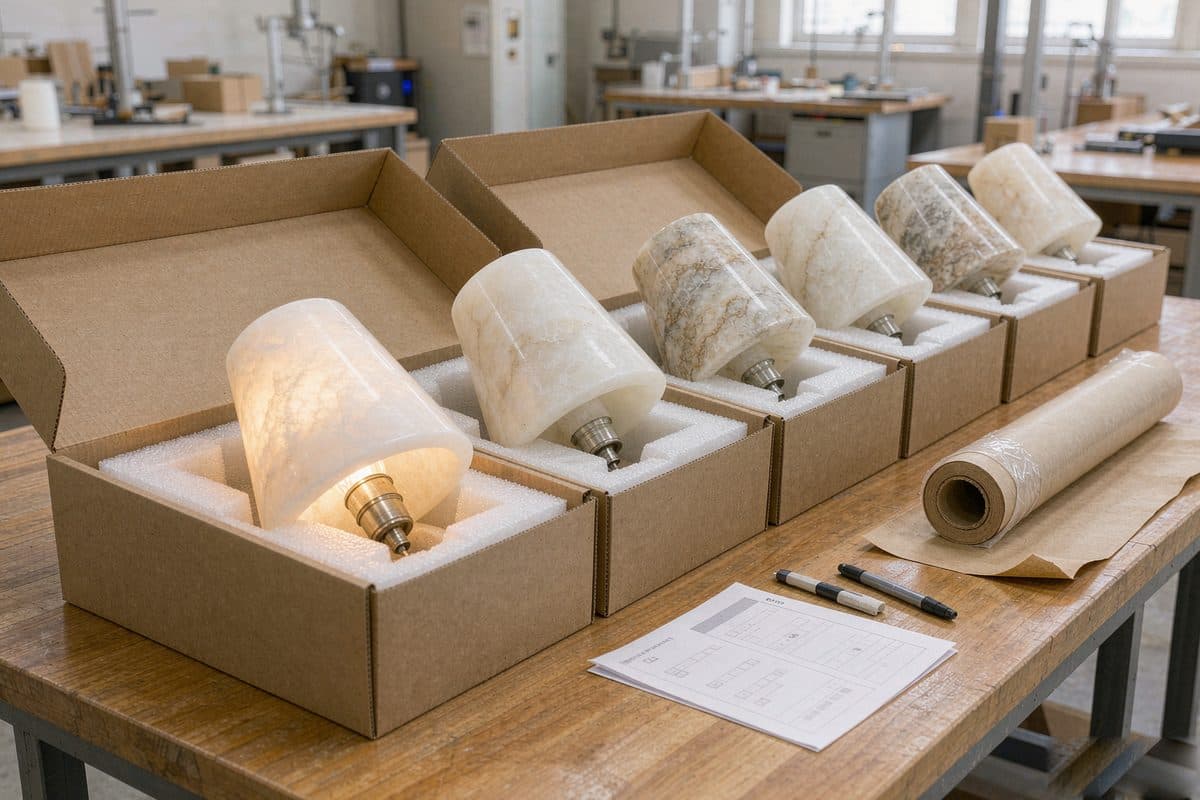
Test on arrival: switch it on in a dark room, check shade mounting for wobble, inspect the veining against the listing photos, test the lamp and (if relevant) a dimmer.
For stone products, request that the sample carton include the retail packing — you are also evaluating the packaging.
Expect 5–10 days of production plus shipping time for samples.
Stage 3: Specification Lock
Before any bulk payment, agree in writing on:
Exact model number and finish (brass / black / nickel; matte vs polished).
Shade size and cord length, including adjustability range.
Lamp compatibility and whether lamps are included.
Packing spec: units per carton, carton dimensions and weight, foam type.
Band matching policy: how similar shades across the order will look. For multi-unit sets, agree on grouping of similar veining.
This one-page specification prevents 90% of disputes.
Stage 4: MOQ and Pricing
Stone lighting MOQs are usually modest because shades are made in batches, not molds. Typical structures:
20–50 pieces per model for standard finishes.
Lower MOQs (even 5–10 pieces) for mixed-model trial orders at slightly higher unit prices.
Custom finishes or sizes generally start at 100+ pieces, because metalwork and stone selection are batch processes.
Ask for tiered pricing (e.g., 50/100/200 units) so growth is pre-priced.
Stage 5: Customization Options
Beyond color and size, stone lighting customizes well in areas buyers don't always expect:
Cord color and length — fabric cords in brand colors are a cheap, high-impact option.
Canopy style — round, square, or multi-hole canopies for clusters.
Hardware finish — brushed, polished or matte metal to match a project scheme.
Lamp bundles — fixtures shipped with matched dimmable LEDs packed inside.
Customization on natural stone has a limit: the stone itself will always surprise you. Build acceptance of natural variation into the contract.
Stage 6: Production and Lead Times
Typical timelines for alabaster/stone lighting:
Order size | Production lead time |
Samples | 5–10 days |
50–100 units | 20–30 days |
200–500 units | 30–45 days |
Custom development | 45–60 days |
Stone production has natural variance — a batch of raw material with problems can add a week. Build 10–15% buffer into launch plans.
Stage 7: Pre-Shipment Inspection
Either visit, or engage a third-party inspection service. The stone-specific checks:
Every shade switched on and inspected for cracks visible only when lit.
Veining consistency across the order (photograph every unit).
Hardware torque and cord grip tests.
Drop tests on packed cartons (see our packaging article for why this matters).
Stage 8: Shipping Terms
Standard options: FOB (you arrange freight), CIF (supplier to your port), or DDP (delivered, duties paid). Stone products add one variable: weight-based freight, which makes carton density worth negotiating — better foam design can reduce volumetric weight significantly. Insure stone shipments; the premium is small relative to the risk.
Stage 9: After Arrival
Inspect a random sample on arrival before the container is emptied. Photograph any damage immediately. Suppliers who took the specification seriously will handle claims seriously — which is why the process starts with the questions you asked in Stage.