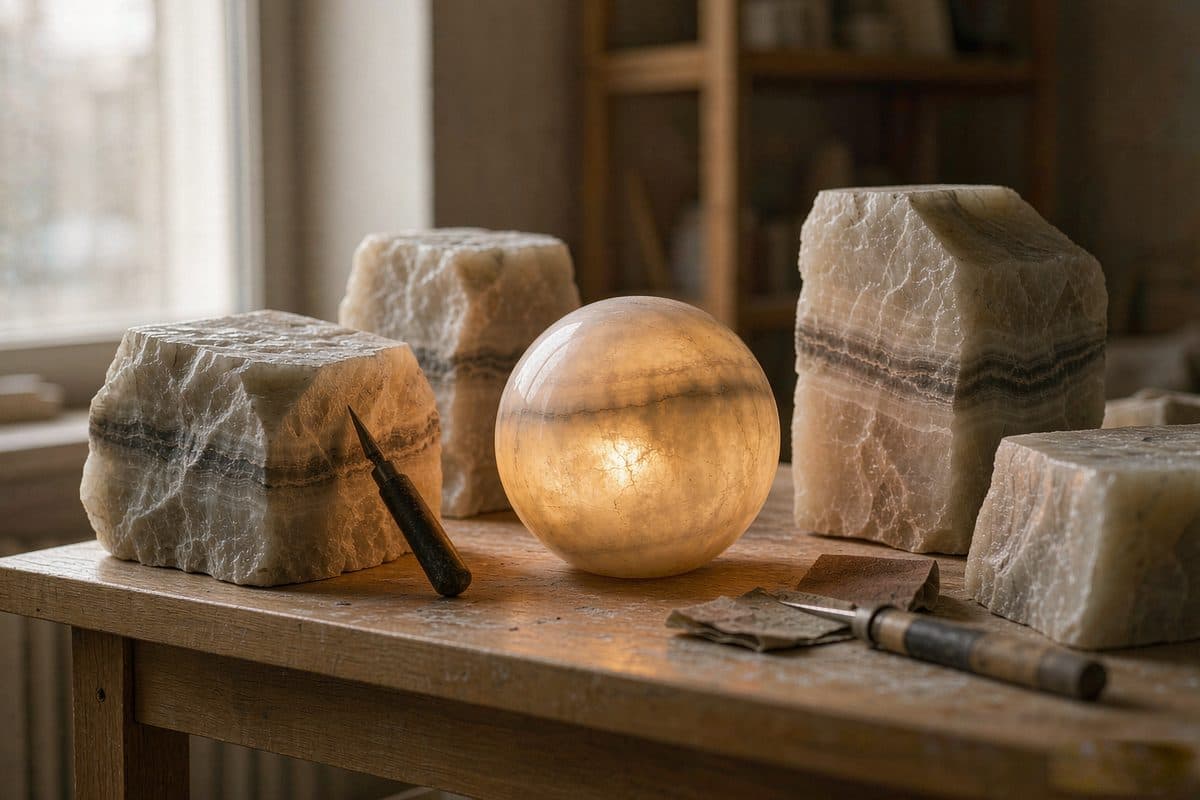
What Alabaster Actually Is
Alabaster is a fine-grained variety of gypsum, chemically calcium sulfate. It is much softer than marble — around 1.5 to 2 on the Mohs scale — which is precisely what makes it so valuable for lighting. A craftsman can shape it with hand tools, and its translucent structure allows light to pass through the material rather than simply reflecting off the surface. When the lamp is switched on, the stone appears to glow from within.
The most prized alabaster comes from Egypt and the Mediterranean region, where the stone forms in banded layers of white, honey, amber and grey. The banding is not a defect: it is the geological record of millions of years of mineral deposits, and it is what makes each shade unique.
Step 1: Quarrying
Alabaster is extracted in large blocks, often several hundred kilograms each. Quarry workers look for continuous veins of consistent color, because a block with a visible crack or a sudden change in banding will fail later during cutting. Good blocks are rare — a significant percentage of extracted stone ends up unsuitable for lighting and is sold for carving or industrial use.
Step 2: Slabbing and Selecting
At the workshop, each block is sliced into slabs of the thickness needed for the shade design. For a globe pendant, craftsmen study the banding and mark where each cut will fall so the finished shade shows balanced, flowing veining instead of an abrupt color break. This selection stage is where cheap and premium suppliers diverge most: careful mapping of the stone takes time and experience, and skipping it shows immediately in the finished product.
Step 3: Shaping the Shade
The shaped shade — dome, globe, cylinder, lantern or a sculpted petal profile — is ground and carved against abrasive wheels and hand files. Because the stone is soft, an experienced craftsman works to tolerances of less than a millimeter. Curved profiles are the hardest: a scalloped or petal silhouette may take several hours of shaping before the edges feel smooth to the touch.
Step 4: Washing, Sanding and Finishing
After shaping, the shade is washed to remove stone dust, then sanded through progressively finer grits. Some designs are left with a matte, chalky finish that emphasizes the stone's natural texture; others are polished lightly to deepen the translucent effect. The finish is usually left unsealed so the stone can breathe — alabaster should never be cleaned with chemical sprays, only a dry or slightly damp cloth.
Step 5: Fitting the Hardware
The stone shade is matched with its metal components — canopy, socket cup, stem and cord — in brass, black steel or another finish. The socket must grip the stone firmly without pressure points, because alabaster can crack under uneven stress. At this stage the fixture also receives its lamp holder (E26, E27 or G9 depending on the model) and the internal wiring.
Step 6: Inspection and Packing
Before packing, every fixture should pass three checks: the shade is switched on and examined for cracks that only appear when light passes through; the hardware is checked for wobble; and the cord grip is tested. Stone is heavy and fragile, so professional packing means individual foam cradles, rigid cartons and — for wholesale orders — drop tests on the packed boxes.