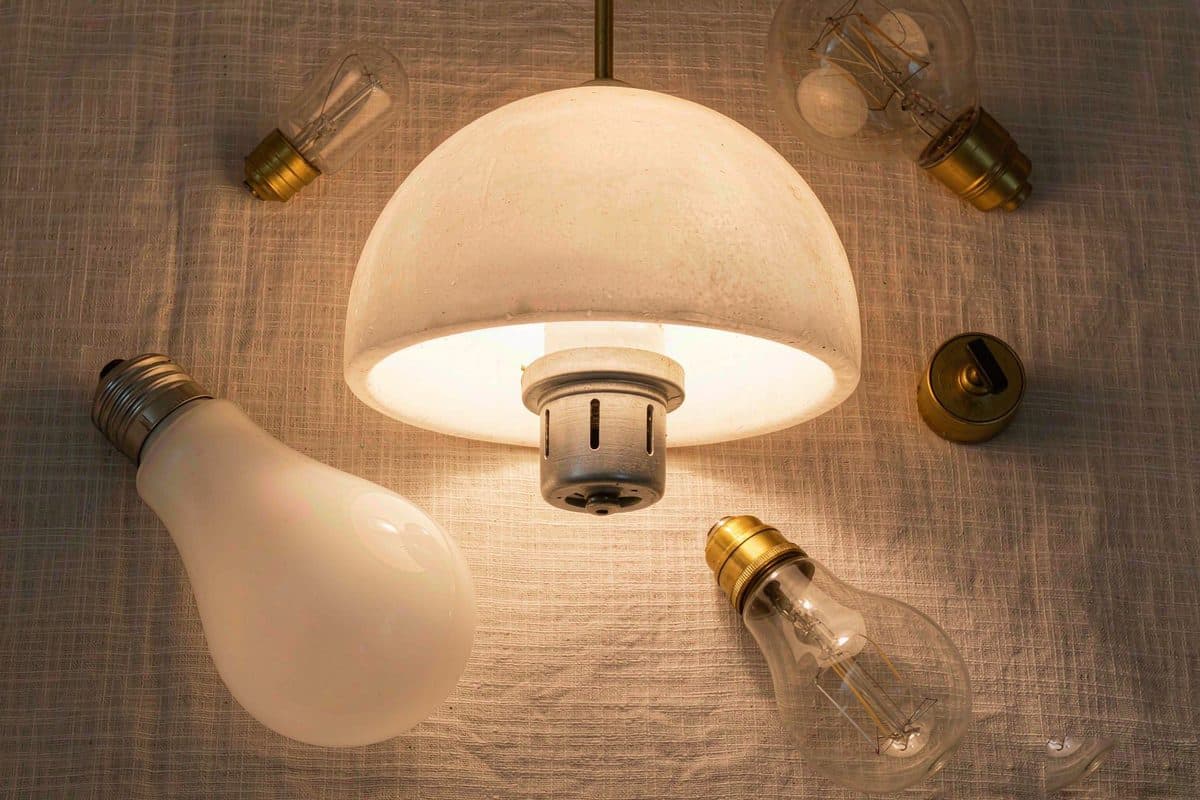
ocket Types: E26, E27 and G9
E26 is the North American standard screw base; E27 is the European and international standard. They are physically almost identical — an E27 lamp usually fits an E26 holder, though the contact may be less reliable, so fixtures should always be matched to the market they are sold into. Most alabaster pendant designs use a screw base because it suits heavier shades and allows easy lamp replacement by the end user.
G9 is a small bi-pin capsule lamp used in compact fixtures — small globes, mini pendants and some wall lights. G9 lamps run hot, and quality matters: cheap capsules flicker and fail early. For stone fixtures, always recommend ceramic-bodied G9 lamps rather than plastic-bodied ones.
LED vs Incandescent: What Actually Changed
Alabaster lighting was historically designed around warm incandescent lamps, which cast light in all directions and glow warmly through the stone. Modern LED lamps reproduce this well if chosen carefully:
Choose LEDs with a high color rendering index (CRI ≥ 90). Low-CRI LEDs make the stone's veining look flat and grey.
Choose 2700K for residential warmth, 3000K for hospitality spaces that need a slightly cleaner look.
Avoid clear-glass LED filaments in enclosed stone shades unless you want visible points of light; frosted lamps distribute light more evenly through the stone.
How Bright Should the Lamp Be?
Because alabaster diffuses light, a stone shade delivers less usable light than an open fixture of the same wattage. Practical starting points:
Application | Recommended output (per shade) |
Bedside / reading corner | 300–450 lumens |
Dining table pendant | 500–800 lumens |
Bar / counter pendant | 400–600 lumens |
Cluster of 3–5 mini pendants | 200–300 lumens each |
Entryway / hallway | 450–600 lumens |
Larger shades can hold brighter lamps because the stone spreads the light; small 8–10 cm globes should stay around 300–400 lumens to avoid glare through thin stone walls.
Dimming: Get the Whole Chain Right
A dimmable LED lamp only dims when three things agree: the lamp is dimmable, the driver inside supports the dimmer type (TRIAC/leading-edge or trailing-edge), and the wall dimmer is compatible. Mismatches produce buzzing, flicker or a limited dimming range.
Recommend to project buyers:
Specify a proven dimmable LED model and test it with the actual dimmer before ordering in bulk.
For hotels, consider leading-edge TRAIC dimmers with adjustable minimum brightness.
Remember that warm-dim lamps (which shift from 2700K to 2200K as they dim) enhance alabaster beautifully — the stone grows more amber as the room gets quieter.
Lamp Access and Replacement
Check how the end user replaces the lamp. Screw-base shades typically open from the bottom; some designs have a removable bottom ring or magnetic cap. Fixtures where the lamp must be threaded through a narrow opening frustrate end users and generate support requests. When comparing suppliers, ask for the lamp-replacement procedure in writing.
Stocking Advice for Wholesale Buyers
Keep a recommended-lamp sheet to include in every carton — it reduces returns dramatically.
Offer a lamp bundle (fixture + matched dimmable LED) as an upsell.
For markets with both 110–120V and 220–240V, confirm the fixture's rated voltage and lamp availability per market before confirming an order.