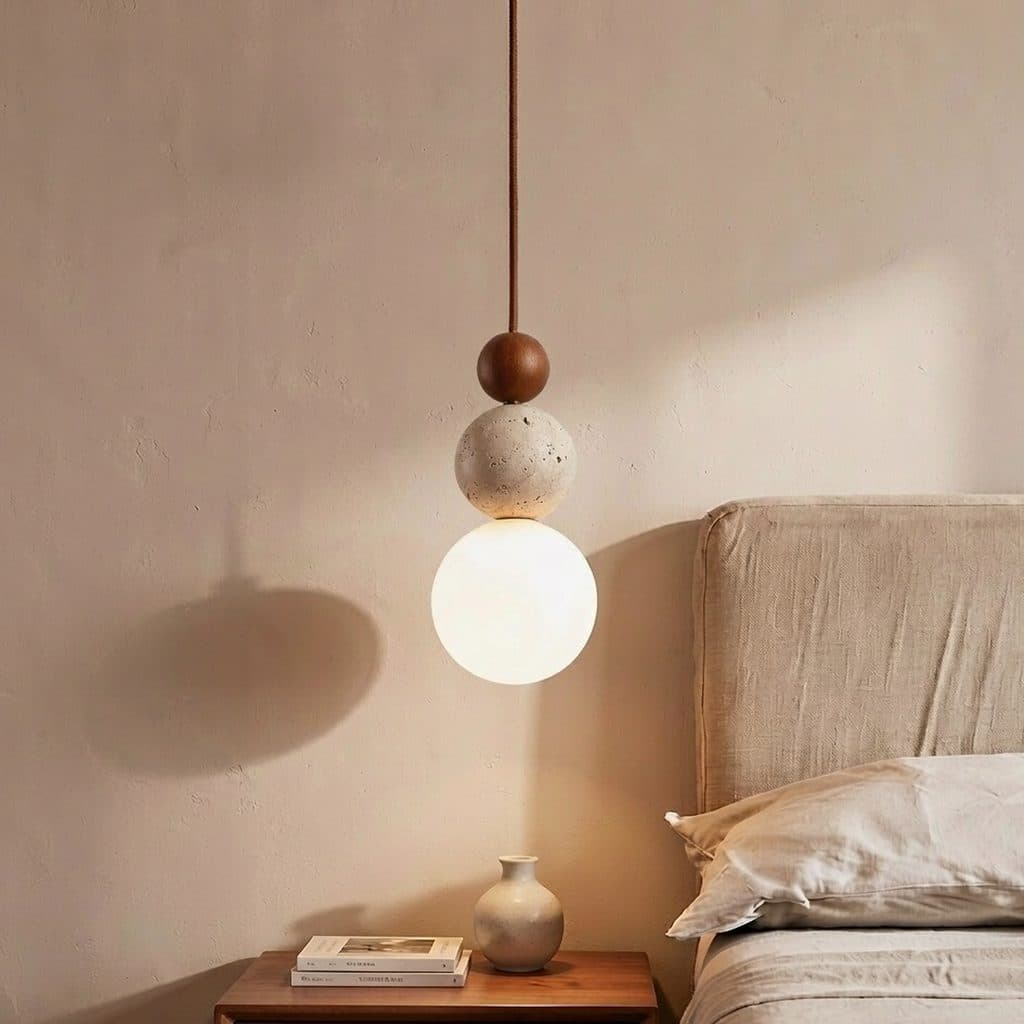
Why Designers Specify Pendants at the Bedside
1. Space. A nightstand typically holds a phone, a book, a glass of water and a lamp. Removing the lamp frees a quarter of the surface.
2. Symmetry. Two identical pendants frame the bed cleanly, especially with floating nightstands.
3. Light quality. Stone shades spread a wide, glare-free pool of light — ideal for reading without harsh downward beams.
4. Aesthetics. A pendant adds vertical rhythm to the wall behind the bed, which matters in rooms with low headboards or no art.
Choosing the Right Shade Size and Shape
Bedside pendants should be small. As a rule:
Globe pendants, 10–15 cm diameter — the classic choice; soft and spherical suits most bedrooms.
Cylinder pendants, 8–10 cm diameter × 15–25 cm tall — modern and architectural; excellent in Japandi and minimalist rooms.
Small dome or lantern shapes — add character in eclectic or boutique-style rooms.
Avoid anything above 20 cm diameter unless the pendant hangs well above head height in a large, tall room.
Placement Rules That Work
Hang the shade roughly 40–55 cm above the nightstand surface, or about 20–30 cm above the mattress top, so it reads during the day and never blocks a sitting person's view across the room.
Position the drop beside the bed, not over the pillow — the sleeper's shoulder area is the natural reading-light position.
If the room has a sloped ceiling, use an angled canopy adapter or move the drop point away from the slope.
Switching and Wiring Options
This is where bedside pendants need more thought than dining pendants:
Wall switch by the bed is the comfort standard — guests should not have to get up to turn the light off. Run the pendant to a bedside switch or a paired wall plate.
Inline cord switch works for retrofits where a switch cannot be wired to the wall.
Smart bulbs + bedside smart controller are a popular hotel retrofit: dimming and timers without new wiring.
For hotel projects, consider a keycard or master-switch system integration, and always specify dimmable lamps — guests vary the light constantly at night.
Styling Combinations That Always Work
Warm minimal: alabaster globe + white bedding + oak nightstand + one ceramic vase. The stone's veining becomes the only decoration.
Japandi: cylinder stone pendant + low platform bed + paper-textured curtains; keep both pendants at identical height for calm.
Classic hotel: two matching pendants in brass-and-stone finish + linen headboard + matching wall paint behind the bed.
Small guest room: one slightly larger pendant centered above a single nightstand instead of two — saves cost and simplifies wiring.
Dark moody bedroom: warm alabaster against deep green or charcoal walls; the stone reads almost candle-like.
Common Mistakes
Hanging the pendant too low — it becomes a head-bump hazard and blocks the view.
Using a bare, non-dimmable high-lumen lamp — bedside light must dim.
Forgetting the second pendant's switch location — each side should be controlled independently.
Matching the pendant metal to the door handles but not to anything in the room itself; the pendant should relate to the bed zone, not the entry.